



 Didi Gluck
The common assumption about Amazon Beauty is that customers arrive knowing exactly what they want to buy. Camille Nordby, Category Leader of Premium Beauty at Amazon, who also leads Worldwide Beauty Customer Experience, said the next generation of shoppers is proving otherwise. “I think one of the reasons that Gen Z really loves Amazon is because of the breadth of our categories and the ways that customers can explore and shop with us,” she said.

And while Gen Z may not have a brand or product in mind when they go beauty shopping, “they’re generally shopping with a high intention behind their need,” whether that’s a specific concern, an ingredient they’ve heard about, or a routine they’ve learned about. They’re also thorough, “going very deep into education and really understanding formulations,” Nordby said.
What makes this shopper a challenge is that there’s no single starting point. “They don’t have a linear customer journey. They have an incredibly dynamic customer journey,” Nordby said, with discovery happening at any point in the day, “from a billboard to their phone to a creator.” For Amazon, that reframes the mission. The aim is to “meet them in those different moments,” and to make sure “our customer journey enables them to connect the dots,” so that Amazon is already part of the journey when the customer decides to buy.
The Early Bird Gets the Customer
A brand that waits for a customer to discover a product page is joining the journey late, Nordby says. She alludes to this year’s recipient of the Customer Obsession Award at CEW’s 2026 Beauty Awards [to be announced November 10] as a great example of what showing up early looks like. The winning brand is showing up with their customers in a place that you wouldn’t necessarily expect to see them,” which Nordby considers an innovative way to become part of the consumer journey long before the moment of purchase.
Creators are another way to get in front of customers. But while Amazon has an extensive creator network that “leans heavily into beauty,” they come in at a different point in the journey than you might expect. A customer may trust a creator for information about a trend or something that “spikes their inspiration and curiosity,” she said, but Amazon still sees those customers turn to the site for product-level information and to read what other shoppers think.
In Amazon We Trust
Inspiration gets a customer curious, but it’s trust that gets her to buy. Nordby said that what Amazon brings to that moment, including product education, brand storytelling, reviews, selection and speed, all add up to the same thing. “Everything we’re doing in beauty is about building and earning that customer trust, and then keeping it,” she said.
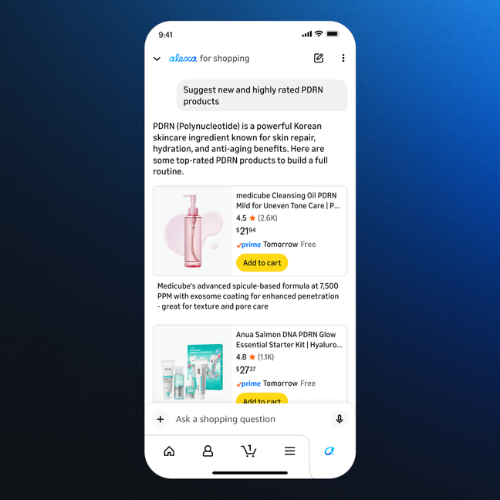
Trust also shapes how Amazon approaches personalization, pointing out Alexa for Shopping as the biggest proof point. Consider a customer who has heard about a trend like PDRN but isn’t sure it’s right for sensitive skin. In that moment, Nordby said Alexa for Shopping, Amazon’s AI-powered shopping agent, can become “a really trusted advisor,” adding that Alexa for Shopping was used by over 400 million customers in the past 12 months, and in the U.S., customers who use Alexa for Shopping spend an average of 50% more per order than those who don’t.
Of course that kind of guidance only works if it feels earned, and Nordby said Amazon tries to avoid being “too heavy-handed with what we know about the customer’s shopping behavior.” But deployed with a light touch, the breadth of Amazon’s business can become an advantage. Because Amazon can “go along with the customer in their journey through many different categories,” it can spot openings elsewhere. For example, a customer who loves fitness might be introduced to premium beauty, and one shopping for premium wellness with a focus on sleep might get served nighttime skin care.
Trendspotting
Seeing across categories also helps Amazon see what’s coming. Many trends begin on Amazon, Nordby says, giving the company “a front row seat to what’s happening.” Her team monitors trends across the industry and aims to be agile in responding, but the goal is to “not just jump on the trend for the sake of it, but maybe educate them about the trend or bring the trend into one place that makes it easy for them to shop.” (See K-Beauty, which has an Amazon storefront organized around its trends.)
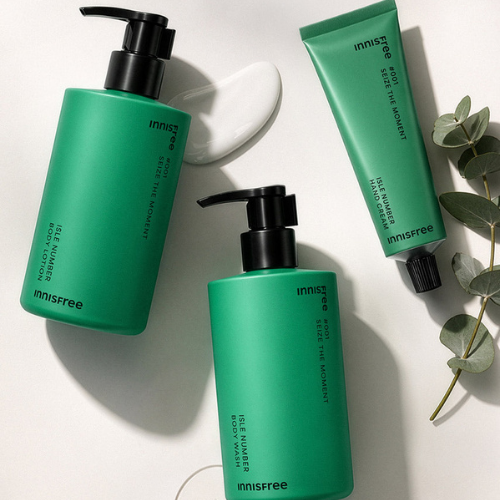
Brands can benefit from Amazon’s insights too. Last year, Nordby said, her team shared what it was seeing with Amorepacific: skin care trends, from ingredients to routines, were becoming relevant in body care, a shift known as the skinification of body care. The conversation turned to body care already available in Korea that had never launched in the U.S., and Amorepacific was open to developing a range for the American market. The result, which Amazon recently launched, is an exclusive Innisfree body range that brings together skinification and K-beauty.
On the Horizon
Nordby’s biggest goal is to close the gap between how customers discover beauty in a store and how they do it online. She wants to create “experiences for our customers that will be as good as being in stores.” She isn’t trying to replace shops, she said, but rather to remove the barrier for customers who live far from one or don’t have the time to get to one.
The piece she most wants to build is “a conversational experience that earns the customer’s trust, that gives them the confidence to address their particular need.” In practice, that means a guided exchange that starts from what a customer is looking for or feeling, brings in education along the way, and leads to a purchase if it’s right for her.
That goal circles back to the misconception about how people shop on Amazon — only when they know what they want — that she’d most like to change. “We have very clear data that shows us that’s just not how customers are shopping there today,” she said. If Amazon Beauty has its way, a customer who doesn’t know what they want yet isn’t a missed sale. It’s a starting point.