



 Andrea Nagel
Today’s headlines highlight how brands are reinventing heritage franchises, embracing emerging consumer behaviors, leveraging technology to accelerate innovation, and delivering strong financial performance despite ongoing economic uncertainty.
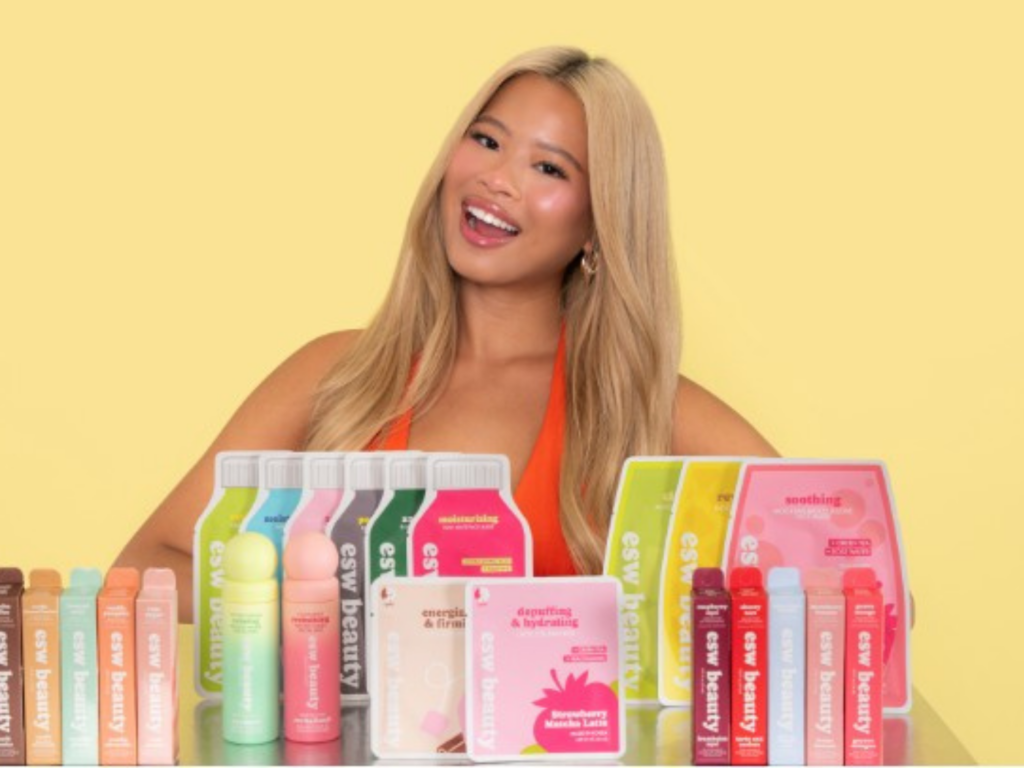
Nearly seven years after launching, ESW Beauty has taken its first outside investment — from two Gen-Z “It” girls, no less. Katie Fang and Aliya Rachinski, who are respectively 20 and 18 years old and, with millions of followers each are among the breakout beauty influencers of their generation, have taken stakes in the skin care brand, becoming its first “creator equity partners.” Terms of the deals were not disclosed, though ESW’s revenue in 2025 is said to have exceeded $11 million, and in 2026 the brand is projected to surpass $20 million in sales. (WWD)
As emerging beauty companies are redefining growth through new partnership models, legacy brands are looking to reinvent themselves. Gap Inc. has launched Gap Beauty, marking its return to the fragrance category with a modernized collection of its iconic scents, repositioned to meet evolving consumer preferences and support the retailer’s broader lifestyle strategy. The launch reintroduces the brand’s original fragrances — Dream, Grass, Heaven, and Om — alongside a new fragrance, Harmony, with all five reformulated as long-lasting eau de parfums using contemporary ingredients and perfumery technologies. Developed in partnership with DSM-Firmenich perfumers, including Honorine Blanc, who created the original fragrances, the collection has been designed to reflect today’s consumer preference for fragrance layering and scent wardrobes rather than a single signature fragrance. Gap said the relaunch forms the first step in its renewed beauty strategy, led by Head of Beauty, Deb Redmond, and Executive Director of Beauty, John Demsey, as the company expands its presence in the beauty sector. (Global Cosmetics News)
Meanwhile, prestige beauty brands continue to invest in fragrance as a key growth category. Burberry Beauty unveils Burberry Goddess Amber Vanilla Eau de Parfum Intense, the new edition in the Burberry Goddess collection. This new scent comes in a refillable bottle. Distinguished from the Burberry Goddess collection, the new Burberry Goddess Amber Vanilla Eau de Parfum Intense introduces an amber gradient on the square glass bottle and outer box. It is adorned with the collection’s signature golden cap and medallion. For the first time, the fragrance is defined by the irresistible warmth of roasted vanilla, revealing a deeper sophisticated femininity and continuing the journey of strength, confidence and self-discovery. Fragrance notes include Lavender and maple syrup accord top notes. The Mid notes are a quartet of vanilla extracts (infusion, caviar, absolute, and roasted), with a base of ambery accord. (Beauty Packaging)
Technology is also reshaping how beauty products are developed behind the scenes. KT and Amorepacific have launched an artificial intelligence (AI) platform designed to turn more than 70 years of beauty research into searchable data, a move the companies say could dramatically shorten the time needed to develop new products. KT said Tuesday that it completed the Data Highway project, which integrated and redesigned data across Amorepacific’s entire R&I Center to create an AI-focused research platform. The project began after KT won the contract in December and entered a strategic partnership with Amorepacific to modernize the company’s research and development data. At the heart of the initiative is the conversion of millions of research and development records accumulated over more than seven decades into what the companies call AI Ready Data. KT said the structured data allows AI to understand and analyze research information without additional processing. The companies also introduced an AI assistant called LEMON, short for Lab Efficiency Mode ON, to help researchers search and analyze research data using natural language. (Red Shift Daily)
Rounding out this week’s news, one of the industry’s largest beauty companies reported continued resilience despite a challenging global environment. Beauty and consumer goods giant Unilever has beaten second-quarter sales growth forecasts saying on Tuesday that it was boosted a bit by higher prices but mainly by improved volume sales, although Personal Care managed to push value sales much higher. Its home care and beauty brands are clearly seen as reliable stalwarts for consumers despite all the uncertainty in the world at present and it’s not suffering from a mass ‘trading down’ effect. The company owns a raft of brands from the mass-market Dove, Sunsilk, TRESemmé and Axe/Lynx to higher-end brands such as Hourglass, Tatcha and Murad. In monetary terms, Q2 turnover was €13 billion, up 3.8%. First-half (H1) turnover was €25.6 billion, up just 0.5%, while underlying operating profit rose 0.9% to €5.2 billion and its reported operating profit was up 2.6% at €4.9 billion. H1 underlying sales growth (USG) was 4.8%, accounted for to the tune of 4.2% by volume and 0.6% by price. Its Power Brands in H1 saw 6% USG and 5.4% was by volume. Those Power Brands accounted for 78% of turnover. (Fashion Network)
Gap Re-Enters Fragrance Market With Relaunched Gap Beauty Brand
TikTok Stars Katie Fang, Aliya Rachinski Take Stakes in ESW Beauty
Burberry Launches Refillable Eau de Parfum
KT, Amorepacific Launch AI Platform to Speed Up Cosmetics R&D
Unilever Beats Expectations in Q2 as Beauty & Personal Care Both Rise