


 Emma Sandler
Sponsored Content
Fragrance, like any art form, must be preserved for future generations. That’s the thinking behind dsm-firmenich’s in-house perfumery school, a decades-long vocational training program designed to train and support the next iteration of perfumers.
First launched in 1977 by Master Perfumer Tony Morris, the program supports 12 trainees at different stages of their learning journey across three programs: fine fragrances, consumer fragrances, and technical fragrances. dsm-firmenich recruits approximately two to four new candidates every year. The school receives hundreds of applicants, and the application process includes meeting with an admissions committee and an olfactory test in which applicants must name or describe unlabeled raw materials and score at least 90%. The next stage is a presentation to a panel on why the applicant believes they are a good fit, the role of a perfumer, and what sets them apart from existing and prospective perfumers. Additionally, applicants must pitch two fragrance concepts.
Even after the tough admissions process, trainees must successfully complete a series of technical exams throughout the multi-year program.
While there’s no physical school or classroom lectures, the program uses a mentorship model with a very international outlook, allowing students to travel to multiple locales, including the famed Grasse, France. However, perfumery is not for the faint of heart, as the program requires a strong scientific understanding, attention to detail in client briefs and, as Olivia Hartnell noted, a former student in the program and now perfumer, the ability to hear the word “no” a lot.
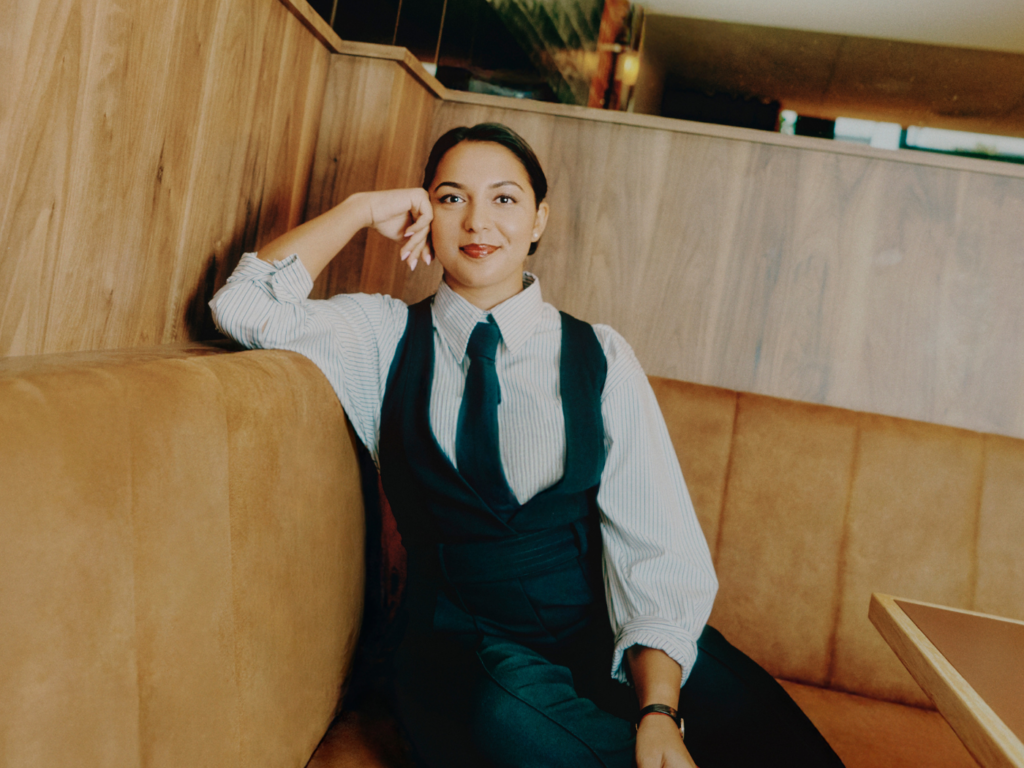
Hartnell previously studied biochemistry at the University of Bristol. For her 21st birthday, her sister gifted her an experience to make her own fragrance, which kick-started her journey to becoming a perfumer. After working in retail at Jo Malone London (Hartnell advises that all perfumers would benefit from a stint in retail) and internships at indie perfume houses, she went to perfume school in Grasse before joining dsm-firmenich in 2021. Hartnell, along with two other applicants, was admitted to the three-year-long program in 2023.
To understand how the perfumery school works, who it’s for, and what students learn, CEW sat down with Hartnell for all the details.
CEW: What do you see as a perfumer’s role?
Olivia Hartnell: At the time [of my admittance to the program], I answered it mostly from an evaluator’s point of view. A client gives a brief, and there are many restrictions around it in terms of safety, price, and olfactive areas you can play with. Back then, I saw the role of perfumery as kind of solving a puzzle. And solving that puzzle in a way that feels right to you, and perhaps more importantly, feels right to the client. You are there to turn that idea, imagination, and emotion into a fragrance. I still see it that way, even after three and a half years of training, but now instead of it being just a puzzle, I see it as a conversation you’re having with the client and the consumer. There’s a story, message, or emotion you want to share, but you also want to leave space for them to create their own interpretation.
CEW: What type of people is this role suitable for?
OH: Someone who understands the reality of being a perfumer. It’s a great job, but you get told no a thousand times more than you get told yes. You have to be an optimist, and you also need integrity and belief in yourself. That also needs to be balanced with humility, because there is always a chance to grow and learn from the experience.
CEW: What does this provide to people in the program?
OH: Access to the top-class perfumers in the industry and their knowledge. Access to incredible resources; we have, if not the best, then one of the best [access] in the industry in terms of raw material quality and size. We also have access to decades of information and innovation. [This program is for those] who really want to push the needle in terms of what the industry looks like.
CEW: What does your work during the program consist of?
OH: The entire time you are a trainee – it’s only when you graduate that you have a perfumer assistant – you are in the lab literally adding all the ingredients yourself. So you’ll be down in the lab compounding a fragrance and then go upstairs to evaluate it, and then back down, etc. It certainly teaches you another level of time management, and you really understand the perfumery process because you follow it all the way through.
Once you’ve graduated and you’re kind of on your own, I think that’s where your style really starts to emerge, and that’s kind of what I’m most looking forward to now; playing around and seeing what feels right to me after taking in all the advice and guidance from my previous mentors over the past three and a half years.
CEW: What is a standout memory to you of this experience?
OH: For me, it was when we were in Grasse in the south of France for four months. We really got to deep-dive into our natural fragrances and visit the jasmine fields in the morning, where workers were literally picking jasmine to use in fragrances for our clients.
I also learned how we create sustainable initiatives and work with local farmers to get the best quality we can while preserving those naturals. We don’t want to be wasteful; we want to cherish these natural ingredients and keep them going for a long time. My experience in Grasse taught me so much about that side of [dsm-firmenich’s work], and it still stands out to me even after all these years.